 based on 6163 reviews


Does Lash Serum Work? Week-by-Week Guide

You've been brushing this stuff on every night for a month. The bottle is half-empty. You've paid somewhere between £30 and £60 for the privilege, and when you lean into the bathroom mirror, your lashes look identical to the ones you had in January. The scepticism is rational. Typing "does any lash serum actually work or is it all just a scam" into Google at 11pm is rational too.
Here's the honest answer: does lash serum work depends on which formula you picked, how long you've been using it, and what you're actually measuring. Some serums genuinely work. Some do very little. Some of the ones that "work" dramatically in four weeks are doing something their ingredient list doesn't admit to. Roughly 35 to 40% of your upper lashes are actively growing at any moment, which means serum can only influence a third of what's on your lid right now. The rest have to cycle through first, and that's why the answer to "is it working?" almost always depends on the calendar. This guide walks you through all of it, so by the end you'll know whether to keep going, switch formulas, or put the bottle down.
What "working" actually means (and why your answer probably isn't length)
You think you want longer lashes. What you actually want is more of them, darker, curled up, and not falling out every time you take your mascara off. Length is one metric. There are four.
The four things a serum can move are length, density, darkness, and curl. Each sits on a different timeline, and each responds to different ingredients. The reason you "can't tell if anything has changed" at week four is often that you're looking for the slowest metric and ignoring the three that have already started shifting.
Length is the hardest win. Genuine length requires ingredients that extend the growth phase of the lash cycle, which is why prescription treatments like Latisse are the gold standard for that specific metric. Peptides, the ingredient class in most UK high-street serums, rarely push length dramatically.
Density moves faster. A well-formulated serum can make your lash line read as fuller and more mascara-ready within a few weeks, even before any new hair has grown. One independent clinical study of an over-the-counter serum measured a 35% increase in thickness and a 50.83% increase in curl after twelve weeks, against only a 10.52% increase in length. The "fuller" effect was three times the "longer" effect.
Darkness and curl are the quickest wins. You'll often see these before anything else, and they're why people post week-six photos that look transformed without any real change in length.
Breakage reduction is the metric everyone ignores. Fewer lashes lost on the cotton pad at night means a denser-looking lash line without a single new hair growing. If you wear mascara daily, use a curler, or pull strip lashes off too fast, breakage reduction alone can change how your eyes look.
Before you decide your serum isn't working, ask which of the four you're actually looking at. And be honest about whether you picked the right formula for the result you want.
PGA vs peptide: why two serums on the same shelf work on totally different timelines
Two bottles. Same shelf. Same price. Same promises on the box. One shows a visible shift at week four, the other at week ten. The difference is one category of ingredient, and once you know which camp your serum is in, the timeline stops being mysterious.
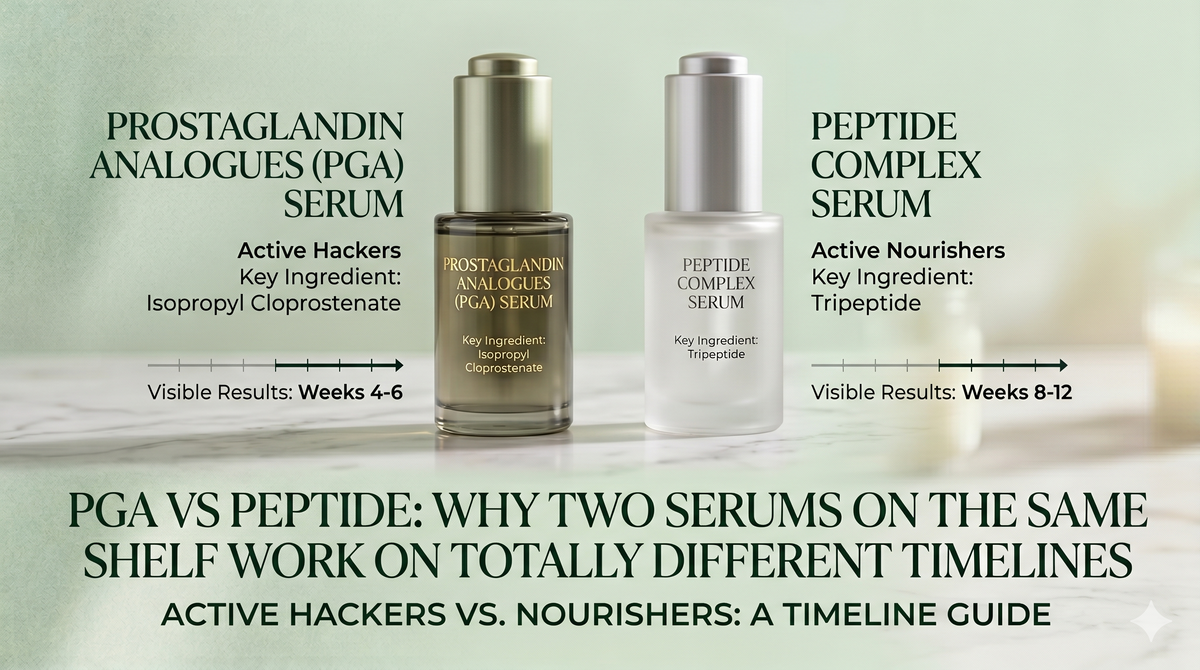
PGAs, or prostaglandin analogues, are the growth-cycle hackers. They extend the anagen phase, the active growth window of your lash cycle. Latisse, the only FDA-approved prescription lash growth treatment, is a PGA, and it delivers roughly a 25% length increase and a 106% thickness increase over sixteen weeks. Over-the-counter PGA cousins include isopropyl cloprostenate and DDDE, the active drivers in brands like GrandeLash and RevitaLash. Expect visible change from week four to week six.
Peptides are the nourishers. They don't change the length of your growth phase. They stimulate keratin production, strengthen the lash shaft, and reduce breakage and shedding. UKLASH and The Ordinary's serum both sit in this camp. Peptides are gentler but slower. Results land at week eight to week twelve, because peptides are gated by how fast your existing lashes cycle through.
As ophthalmologist Dr Rupa Wong puts it: "Latisse is the only one that can legally say it grows lashes. Peptides likely just nourish lashes." That's not a dismissal. Nourished, unbroken lashes look dramatically better than stressed, snapping ones.
The trade-off is real. PGAs are faster, but side effects include lid skin darkening, very rare iris pigment changes in coloured eyes, and orbital fat changes with long-term use. Peptides come with essentially none of that.
Red flag: A cheap serum delivering dramatic week-four results with no PGAs on the ingredient list is worth being suspicious of. Lab Muffin Beauty Science has flagged this exact pattern. In October 2024, RevitaLash settled a class action for £4.17 million over its transparency around a prostaglandin-like compound. Read the INCI list twice.
Check your ingredient list before writing your serum off. Knowing whether you're running a PGA or a peptide tells you which timeline to measure against, and saves you quitting at the wrong week.
The real week-by-week timeline (and why week 4 makes everyone quit)
If you started a peptide serum tonight, here's what you'd see and not see over the next twelve weeks. Most UK buyers are on a peptide, so this is the timeline we'll walk through. If you're on a PGA, shift every milestone three to four weeks earlier.
Weeks 1 to 2. No visible change. You may notice some shedding, and your brain will interpret that as the serum making things worse. It isn't. Those lashes were already scheduled to fall out on their natural cycle. You're just paying attention now.
Weeks 3 to 4. Your lashes feel stronger. Fewer of them land on your cheek when you remove mascara. The mirror still looks the same. This is the single most common quitting point, and UKLASH's own customer care team has flagged week four as where drop-off concentrates.
If you're at week 4 and about to quit: you're two weeks away from the first visible change. The people posting twelve-week transformations on TikTok didn't know at week four whether it was going to work for them either. Keep going. Switching bottles now just resets the clock.
Weeks 5 to 6. First real visible shifts. The outer corners, which carry your shortest and fastest-cycling lashes, start filling in. You'll spot a subtle darkness change along the lash line too. This is the first week you'll look at a photo and say, okay, something is happening.
Weeks 7 to 8. Length and density become noticeable in the mirror without needing a before photo. This is when people start receiving unprompted comments, and when most users commit to the bottle.
Weeks 9 to 12. Maximum results. At week twelve, switch to maintenance dosing of two to three applications per week instead of nightly. Your lashes are as full and long as this formula will take them.
After you stop. Lashes return to baseline over three to six months. One Mumsnet user summed it up: "since I've stopped using it they've gone back to normal which makes me wonder what the hell is in it." What's in it is working, and when it stops, your lashes stop being affected by it. That's the trade.
YouTube creator The Luxury Scientist put the consistency point well in her seven-week update: "I fell off a bit after day 24. I was not consistent. Don't be like me. But look, these are my results. Even being inconsistent." Sloppy application produces results. Proper application produces better ones. Apply it properly and you remove the guesswork.
Why it takes this long: the lash cycle, explained without the biology lecture
Only 35 to 40% of your upper lashes are actively growing right now. The rest are resting. Serum cannot grow what isn't growing yet, and that one sentence explains the entire twelve-week wait.
Your lashes run on a three-phase cycle. Anagen is the growth phase, lasting 30 to 45 days. Catagen is a two to three week transition phase, where the lash stops growing. Telogen is the rest phase, three to four months long, where the lash sits dormant before eventually shedding and being replaced. Full cycle end to end: roughly five to eleven weeks, depending on the individual lash.
The maths is what matters. If only 35 to 40% of your lashes are in anagen today, the other 60 to 65% are in catagen or telogen and cannot be influenced by anything you brush onto the lid. They have to cycle through first. That's why serum brands keep pointing at the twelve-week mark: by then, enough of your total lash population has cycled through anagen at least once under the serum's influence that you see the aggregate effect rather than a scattered one.
Peptide serums are fully gated by this cycle. They can only act on lashes already in the growth phase, and they wait for the next batch to arrive. PGA serums take a different route by extending the anagen phase itself, which is why they show results three to four weeks earlier than peptides. They're not faster because they're stronger. They're faster because they change the cycle rather than working within it.
Using serum while you wear false lashes or extensions
If you wear false lashes, lash serum isn't just compatible. It's arguably more useful for you than for anyone else. Adhesive stress, removal, and the weight of extensions all damage the natural lashes underneath, and a serum repairs that damage between wears.
If you're a strip lash wearer, apply serum on no-strip days, or at bedtime after you've removed your lashes and cleaned off every trace of adhesive. Let it dry fully before you apply glue the next day. Your results will track the same twelve-week curve as anyone else's.
If you wear extensions, the rules tighten. Use oil-free peptide serums only. Oil dissolves the cyanoacrylate adhesive that holds your extensions on, and an oily serum will shorten your retention dramatically. Apply along the upper lash line at skin level, right where the follicles sit, not onto the extensions themselves. A stronger natural lash retains extensions for longer, so the serum pays you back twice.
Here's the angle most brands won't tell you: if you wear strip lashes or extensions regularly, your natural lashes have taken breakage damage, full stop. Peptide serum's real job for you isn't growth. It's reducing further breakage so your own lashes can rebuild underneath what you're wearing on top.
Practical order on a lash day: remove your strip lashes, cleanse thoroughly to break down every bit of glue residue, dry the lash line with a clean cotton pad, then apply serum. It takes about 40 seconds. We sell lashes and we sell serum, and we're not going to pretend that's a contradiction. Wear your lashes. Look after what's underneath. Both can be true. Our full serum range is here when you're ready.
When lash serum genuinely won't work for you
Serum isn't a universal fix. There are specific situations where no product on the market will deliver the result you want, and it's better to know now than after three bottles and six months of hoping.
Post-chemotherapy follicle damage is the most common example. Around 42.5% of patients see partial lash regrowth after chemo, and some see none at all. Certain agents, including docetaxel, can cause permanent follicle damage that no topical product can override. If you're more than twelve months post-treatment with no return, speak to your GP or a trichologist before buying another serum.
Alopecia areata and other autoimmune conditions involve your immune system actively attacking the hair follicle. A topical serum on the lid cannot override an immune response happening inside the follicle. This needs a medical route, not a cosmetic one.
Certain medications and hormonal conditions can also cause lash loss that serum cannot counteract until the underlying cause is addressed. Thyroid conditions, some retinoids, and significant hormonal shifts all fall into this category. The serum may help at the margins, but it can't fix the upstream cause.
For everyone else, the twelve-week rule is the decision point. Correctly applied serum, nightly, to a properly cleansed lash line, for twelve weeks or more, with zero measurable change in length, density, darkness, or curl, is a signal to switch formula class, from peptide to PGA or vice versa, or to speak to a medical professional. It is not a signal to buy the same formula again in hope.
How to actually judge your own results
You will not notice your lashes changing. The change is too slow, and you see your face every day. This is why every serum brand on Instagram uses before-and-after photos. Not because it looks more dramatic. Because it's the only way to see the change at all.
Take the photo on day one. Phone camera, natural light from the same window, eyes open in one shot and closed in another, close-up on one eye. Date the photo in your camera roll. Do not skip this step. Every frustrated reviewer on the internet skipped this step.
Repeat the photo at week four, week eight, and week twelve. Same lighting, same angle, same time of day, no mascara, no curler. You're removing every variable except the serum. Then judge against the photo, not the mirror. Look first for outer-corner fill-in, because your outer lashes are shortest and cycle fastest, so they respond first. Then lash line darkness, individual lash length, and overall density, in that order.
Track your shedding too. Count the lashes on your cheek or in your mascara tube each morning for a week on day one, then repeat the count at week six. A reduction in shedding is the fastest signal a peptide serum is working, and without counting, it's completely invisible to you.
Frequently asked questions about lash serum
How long does lash serum take to work?
Four to six weeks for PGA-based serums, eight to twelve weeks for peptide-based ones. Outer corners fill in first, then overall density, then length. If you're at week four seeing nothing, you're almost certainly on a peptide and roughly two weeks away from your first visible shift.
Does lash serum really work, or is it a placebo?
The effective ones genuinely work. One independent clinical study measured a 35% increase in thickness and a 50.83% increase in curl over twelve weeks against baseline. Prescription PGAs like Latisse deliver even larger shifts. Conditioning-only formulas without peptides or active growth ingredients won't meaningfully move any of the four metrics.
Do lash serum results last after you stop using it?
No. Lashes return to baseline over three to six months once you stop, because your natural lash cycle continues regardless of what you were putting on it. Most people switch to maintenance dosing of two to three applications per week at week twelve rather than stopping outright.
Can I use lash serum with mascara or lash extensions?
Yes to both. Apply at night, after removing makeup, onto a cleansed and dried lash line. With extensions, you must use an oil-free peptide serum, because oil dissolves the cyanoacrylate adhesive holding them on. Apply at skin level along the follicle base, not onto the extensions themselves.
What happens if I miss a few nights?
Nothing disastrous. Results slow rather than reset. Missing a night pushes your timeline out slightly but doesn't undo progress. Consistency is the target. Perfection isn't required.
Ready to pick a formula and actually start the clock? Browse our full lash serum edit and we'll see you at week twelve.
Take our quick quiz to find the best lashes for your eye shape! Join tens of thousands of customers and shop with confidence.
Find your eye shape


